Can Human Memories Be Upload to a Computer?
Mind uploading, also known equally whole brain emulation (WBE), is the theoretical futuristic process of scanning a physical structure of the brain accurately enough to create an emulation of the mental state (including long-term retention and "self") and transferring or copying it to a figurer in a digital form. The computer would then run a simulation of the brain's information processing, such that it would answer in essentially the same way as the original brain and experience having a sentient conscious mind.[1] [two] [3]
Substantial mainstream research in related areas is existence conducted in animal brain mapping and simulation, development of faster supercomputers, virtual reality, brain–computer interfaces, connectomics, and data extraction from dynamically functioning brains.[four] Co-ordinate to supporters, many of the tools and ideas needed to achieve mind uploading already be or are currently under active development; however, they will admit that others are, as notwithstanding, very speculative, but say they are notwithstanding in the realm of engineering possibility.
Mind uploading may potentially be accomplished by either of two methods: copy-and-upload or copy-and-delete by gradual replacement of neurons (which can exist considered equally a gradual destructive uploading), until the original organic brain no longer exists and a estimator program emulating the brain takes control over the trunk. In the case of the former method, mind uploading would be achieved by scanning and mapping the salient features of a biological brain, and then by storing and copying, that information state into a reckoner organization or some other computational device. The biological brain may not survive the copying process or may be deliberately destroyed during it in some variants of uploading. The faux listen could exist within a virtual reality or faux world, supported past an anatomic 3D body simulation model. Alternatively, the simulated mind could reside in a computer inside (or either connected to or remotely controlled) a (non necessarily humanoid) robot or a biological or cybernetic body.[5]
Among some futurists and within the part of transhumanist move, mind uploading is treated as an of import proposed life extension engineering science. Some believe listen uploading is humanity'southward current best selection for preserving the identity of the species, as opposed to cryonics. Another aim of mind uploading is to provide a permanent backup to our "mind-file", to enable interstellar space travel, and a means for human civilisation to survive a global disaster past making a functional re-create of a man order in a calculating device. Whole-brain emulation is discussed by some futurists as a "logical endpoint"[5] of the topical computational neuroscience and neuroinformatics fields, both near encephalon simulation for medical research purposes. It is discussed in artificial intelligence enquiry publications as an arroyo to strong AI (artificial general intelligence) and to at least weak superintelligence. Another approach is seed AI, which wouldn't exist based on existing brains. Calculator-based intelligence such as an upload could call back much faster than a biological homo fifty-fifty if information technology were no more than intelligent. A large-scale society of uploads might, co-ordinate to futurists, give rise to a technological singularity, significant a sudden time constant decrease in the exponential development of technology.[6] Heed uploading is a central conceptual feature of numerous science fiction novels, films, and games.
Overview [edit]
The established neuroscientific consensus is that the human being mind is largely an emergent property of the information processing of its neuronal network.[vii]
Neuroscientists have stated that important functions performed by the heed, such as learning, retention, and consciousness, are due to purely physical and electrochemical processes in the encephalon and are governed by applicable laws. For example, Christof Koch and Giulio Tononi wrote in IEEE Spectrum:
Consciousness is part of the natural globe. It depends, we believe, merely on mathematics and logic and on the imperfectly known laws of physics, chemical science, and biology; information technology does non ascend from some magical or otherworldly quality.[8]
The concept of listen uploading is based on this mechanistic view of the mind, and denies the vitalist view of human life and consciousness.[9]
Eminent computer scientists and neuroscientists have predicted that advanced computers volition be capable of thought and even attain consciousness, including Koch and Tononi,[8] Douglas Hofstadter,[10] Jeff Hawkins,[10] Marvin Minsky,[xi] Randal A. Koene, and Rodolfo Llinás.[12]
Many theorists have presented models of the brain and have established a range of estimates of the amount of computing power needed for partial and complete simulations.[5] [ commendation needed ] Using these models, some have estimated that uploading may become possible within decades if trends such as Moore'southward law continue.[xiii]
Theoretical benefits and applications [edit]
"Immortality" or backup [edit]
In theory, if the information and processes of the mind can be disassociated from the biological body, they are no longer tied to the individual limits and lifespan of that torso. Furthermore, information within a brain could be partly or wholly copied or transferred to one or more than other substrates (including digital storage or some other brain), thereby – from a purely mechanistic perspective – reducing or eliminating "mortality take chances" of such information. This general proposal was discussed in 1971 by biogerontologist George M. Martin of the University of Washington.[14]
Space exploration [edit]
An "uploaded astronaut" could be used instead of a "live" astronaut in human spaceflight, avoiding the perils of null gravity, the vacuum of space, and cosmic radiation to the human torso. It would permit for the use of smaller spacecraft, such as the proposed StarChip, and it would enable virtually unlimited interstellar travel distances.[15]
Relevant technologies and techniques [edit]
The focus of mind uploading, in the case of re-create-and-transfer, is on information acquisition, rather than data maintenance of the brain. A set up of approaches known equally loosely coupled off-loading (LCOL) may be used in the attempt to characterize and copy the mental contents of a brain.[sixteen] The LCOL arroyo may take advantage of self-reports, life-logs and video recordings that can be analyzed by artificial intelligence. A bottom-up approach may focus on the specific resolution and morphology of neurons, the spike times of neurons, the times at which neurons produce activity potential responses.
Computational complication [edit]

Estimates of how much processing power is needed to emulate a human brain at various levels, forth with the fastest and slowest supercomputers from TOP500 and a $thou PC. Notation the logarithmic scale. The (exponential) trend line for the fastest supercomputer reflects a doubling every xiv months. Kurzweil believes that mind uploading will be possible at neural simulation, while the Sandberg & Bostrom report is less certain nigh where consciousness arises.[17]
Advocates of heed uploading point to Moore's law to support the notion that the necessary computing power is expected to become available inside a few decades. However, the actual computational requirements for running an uploaded human mind are very difficult to quantify, potentially rendering such an argument specious.
Regardless of the techniques used to capture or recreate the function of a human being mind, the processing demands are likely to exist immense, due to the large number of neurons in the human brain forth with the considerable complexity of each neuron.
In 2004, Henry Markram, lead researcher of the Blue Brain Project, stated that "it is not [their] goal to build an intelligent neural network", based solely on the computational demands such a project would accept.[eighteen]
Information technology will be very hard because, in the brain, every molecule is a powerful estimator and nosotros would demand to simulate the structure and function of trillions upon trillions of molecules as well as all the rules that govern how they interact. You would literally need computers that are trillions of times bigger and faster than anything existing today.[nineteen]
Five years later, subsequently successful simulation of office of a rat brain, Markram was much more assuming and optimistic. In 2009, as managing director of the Blue Brain Project, he claimed that "A detailed, functional bogus homo brain can exist built within the next x years".[20] Less than two years into it, the projection was recognised to exist mismanaged and its claims overblown, and Markram was asked to footstep downwards.[21] [22]
Required computational capacity strongly depend on the chosen level of simulation model scale:[5]
| Level | CPU need (FLOPS) | Retention demand (Tb) | $1 meg super‐calculator (Primeval year of making) |
| Analog network population model | 1015 | tenii | 2008 |
| Spiking neural network | 1018 | ten4 | 2019 |
| Electrophysiology | ten22 | ten4 | 2033 |
| Metabolome | 1025 | 106 | 2044 |
| Proteome | 1026 | xvii | 2048 |
| States of protein complexes | x27 | ten8 | 2052 |
| Distribution of complexes | 1030 | 109 | 2063 |
| Stochastic beliefs of single molecules | x43 | 1014 | 2111 |
Scanning and mapping calibration of an individual [edit]
When modelling and simulating the brain of a specific individual, a brain map or connectivity database showing the connections betwixt the neurons must exist extracted from an anatomic model of the encephalon. For whole brain simulation, this network map should show the connectivity of the whole nervous system, including the spinal cord, sensory receptors, and muscle cells. Destructive scanning of a small sample of tissue from a mouse encephalon including synaptic details is possible as of 2010.[23]
Nonetheless, if short-term memory and working memory include prolonged or repeated firing of neurons, as well as intra-neural dynamic processes, the electrical and chemical signal state of the synapses and neurons may exist hard to excerpt. The uploaded mind may then perceive a retentiveness loss of the events and mental processes immediately before the fourth dimension of brain scanning.[5]
A full brain map has been estimated to occupy less than 2 10 1016 bytes (xx,000 TB) and would store the addresses of the connected neurons, the synapse type and the synapse "weight" for each of the brains' x15 synapses.[5] [ failed verification ] Notwithstanding, the biological complexities of truthful brain function (eastward.g. the epigenetic states of neurons, poly peptide components with multiple functional states, etc.) may preclude an authentic prediction of the volume of binary data required to faithfully correspond a functioning human listen.
Serial sectioning [edit]

Series sectioning of a brain
A possible method for mind uploading is serial sectioning, in which the brain tissue and perchance other parts of the nervous arrangement are frozen and and so scanned and analyzed layer by layer, which for frozen samples at nano-scale requires a cryo-ultramicrotome, thus capturing the structure of the neurons and their interconnections.[24] The exposed surface of frozen nerve tissue would be scanned and recorded, and so the surface layer of tissue removed. While this would be a very slow and labor-intensive procedure, research is currently underway to automate the collection and microscopy of series sections.[25] The scans would so be analyzed, and a model of the neural net recreated in the organization that the mind was beingness uploaded into.
There are uncertainties with this approach using current microscopy techniques. If it is possible to replicate neuron part from its visible structure alone, then the resolution afforded past a scanning electron microscope would suffice for such a technique.[25] Nonetheless, as the office of brain tissue is partially determined by molecular events (particularly at synapses, but also at other places on the neuron'southward cell membrane), this may not suffice for capturing and simulating neuron functions. It may be possible to extend the techniques of series sectioning and to capture the internal molecular makeup of neurons, through the use of sophisticated immunohistochemistry staining methods that could then be read via confocal light amplification by stimulated emission of radiation scanning microscopy. However, as the physiological genesis of 'listen' is non currently known, this method may non be able to access all of the necessary biochemical information to recreate a human brain with sufficient fidelity.
Brain imaging [edit]

Process from MRI acquisition to whole brain structural network[26]
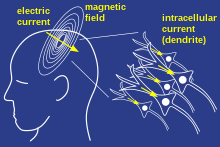
Information technology may be possible to create functional 3D maps of the brain action, using advanced neuroimaging technology, such as functional MRI (fMRI, for mapping alter in blood flow), magnetoencephalography (MEG, for mapping of electric currents), or combinations of multiple methods, to build a detailed iii-dimensional model of the brain using not-invasive and non-destructive methods. Today, fMRI is often combined with Meg for creating functional maps of human cortex during more complex cognitive tasks, equally the methods complement each other. Fifty-fifty though current imaging technology lacks the spatial resolution needed to gather the data needed for such a scan, important contempo and future developments are predicted to essentially amend both spatial and temporal resolutions of existing technologies.[27]
Brain simulation [edit]
In that location is ongoing piece of work in the field of brain simulation, including partial and whole simulations of some animals. For case, the C. elegans roundworm, Drosophila fruit wing, and mouse have all been simulated to various degrees.[ citation needed ]
The Blue Brain Project by the Encephalon and Mind Plant of the École Polytechnique Fédérale de Lausanne, Switzerland is an attempt to create a synthetic brain by contrary-engineering mammalian brain circuitry.
Issues [edit]
Practical problems [edit]
![[icon]](https://upload.wikimedia.org/wikipedia/commons/thumb/1/1c/Wiki_letter_w_cropped.svg/20px-Wiki_letter_w_cropped.svg.png) | This department needs expansion. You tin aid past adding to it. (June 2020) |
Kenneth D. Miller, a professor of neuroscience at Columbia and a co-director of the Heart for Theoretical Neuroscience, raised doubts about the practicality of mind uploading. His major argument is that reconstructing neurons and their connections is in itself a formidable task, only it is far from being sufficient. Functioning of the brain depends on the dynamics of electrical and biochemical signal exchange between neurons; therefore, capturing them in a unmarried "frozen" land may evidence insufficient. In addition, the nature of these signals may crave modeling down to the molecular level and beyond. Therefore, while not rejecting the idea in principle, Miller believes that the complexity of the "absolute" duplication of an individual mind is insurmountable for the nearest hundreds of years.[28]
Philosophical issues [edit]
Underlying the concept of "mind uploading" (more accurately "mind transferring") is the broad philosophy that consciousness lies inside the brain'southward information processing and is in essence an emergent characteristic that arises from large neural network high-level patterns of organization, and that the same patterns of organisation can exist realized in other processing devices. Mind uploading also relies on the idea that the man mind (the "self" and the long-term retentiveness), only similar non-man minds, is represented by the current neural network paths and the weights of the brain synapses rather than by a dualistic and mystic soul and spirit. The mind or "soul" can exist defined equally the information state of the brain, and is immaterial but in the same sense as the data content of a data file or the state of a computer software currently residing in the piece of work-infinite retentivity of the computer. Data specifying the information land of the neural network can be captured and copied equally a "computer file" from the brain and re-implemented into a different physical form.[29] This is not to deny that minds are richly adapted to their substrates.[xxx] An analogy to the thought of listen uploading is to re-create the temporary information state (the variable values) of a figurer program from the computer retention to some other computer and continue its execution. The other estimator may perhaps have dissimilar hardware architecture but emulates the hardware of the start calculator.
These issues have a long history. In 1775, Thomas Reid wrote:[31] "I would be glad to know... whether when my brain has lost its original structure, and when some hundred years after the same materials are fabricated then curiously as to become an intelligent existence, whether, I say that being will exist me; or, if, two or iii such beings should exist formed out of my brain; whether they will all exist me, and consequently 1 and the aforementioned intelligent being."
A considerable portion of transhumanists and singularitarians place great hope into the belief that they may become immortal, by creating 1 or many non-biological functional copies of their brains, thereby leaving their "biological beat". However, the philosopher and transhumanist Susan Schneider claims that at all-time, uploading would create a copy of the original person's mind.[32] Schneider agrees that consciousness has a computational ground, but this does non mean we can upload and survive. According to her views, "uploading" would probably result in the death of the original person'southward encephalon, while but outside observers tin maintain the illusion of the original person even so being live. For it is implausible to think that 1's consciousness would go out one'southward brain and travel to a remote location; ordinary physical objects do not behave this fashion. Ordinary objects (rocks, tables, etc.) are not simultaneously here, and elsewhere. At all-time, a copy of the original listen is created.[32] Neural correlates of consciousness, a sub-branch of neuroscience, states that consciousness may be thought of every bit a state-dependent belongings of some undefined complex, adaptive, and highly interconnected biological system.[33]
Others accept argued confronting such conclusions. For case, Buddhist transhumanist James Hughes has pointed out that this consideration only goes so far: if 1 believes the cocky is an illusion, worries about survival are not reasons to avert uploading,[34] and Keith Wiley has presented an argument wherein all resulting minds of an uploading procedure are granted equal primacy in their merits to the original identity, such that survival of the self is adamant retroactively from a strictly subjective position.[35] [36] Some have also asserted that consciousness is a part of an extra-biological system that is yet to be discovered; therefore it cannot exist fully understood under the present constraints of neurobiology. Without the transference of consciousness, truthful listen-upload or perpetual immortality cannot be practically accomplished.[37]
Some other potential consequence of listen uploading is that the determination to "upload" may then create a mindless symbol manipulator instead of a conscious mind (see philosophical zombie).[38] [39] Are we to assume that an upload is conscious if it displays behaviors that are highly indicative of consciousness? Are nosotros to assume that an upload is conscious if it verbally insists that information technology is conscious?[40] Could there be an absolute upper limit in processing speed in a higher place which consciousness cannot exist sustained? The mystery of consciousness precludes a definitive respond to this question.[41] Numerous scientists, including Kurzweil, strongly believe that the answer as to whether a split up entity is conscious (with 100% confidence) is fundamentally unknowable, since consciousness is inherently subjective (encounter solipsism). Regardless, some scientists strongly believe consciousness is the consequence of computational processes which are substrate-neutral. On the contrary, numerous scientists believe consciousness may be the result of some course of breakthrough computation dependent on substrate (run into quantum listen).[42] [43] [44]
In light of uncertainty on whether to regard uploads every bit conscious, Sandberg proposes a cautious arroyo:[45]
Principle of assuming the virtually (PAM): Assume that any emulated system could have the same mental backdrop as the original system and care for it correspondingly.
Ethical and legal implications [edit]
The process of developing emulation technology raises ethical issues related to animal welfare and artificial consciousness.[45] The neuroscience required to develop encephalon emulation would require animal experimentation, first on invertebrates and so on small mammals earlier moving on to humans. Sometimes the animals would but need to be euthanized in guild to extract, piece, and scan their brains, but sometimes behavioral and in vivo measures would exist required, which might cause hurting to living animals.[45]
In addition, the resulting brute emulations themselves might suffer, depending on one's views nigh consciousness.[45] Bancroft argues for the plausibility of consciousness in brain simulations on the ground of the "fading qualia" thought experiment of David Chalmers. He then concludes:[46] "If, every bit I argue to a higher place, a sufficiently detailed computational simulation of the encephalon is potentially operationally equivalent to an organic brain, it follows that we must consider extending protections against suffering to simulations."
It might assistance reduce emulation suffering to develop virtual equivalents of anaesthesia, as well equally to omit processing related to pain and/or consciousness. Nonetheless, some experiments might require a fully functioning and suffering beast emulation. Animals might as well suffer by accident due to flaws and lack of insight into what parts of their brains are suffering.[45] Questions too arise regarding the moral condition of partial brain emulations, as well as creating neuromorphic emulations that draw inspiration from biological brains just are congenital somewhat differently.[46]
Brain emulations could exist erased past computer viruses or malware, without need to destroy the underlying hardware. This may brand assassination easier than for physical humans. The assaulter might have the calculating ability for its own use.[47]
Many questions arise regarding the legal personhood of emulations.[48] Would they be given the rights of biological humans? If a person makes an emulated copy of themselves so dies, does the emulation inherit their belongings and official positions? Could the emulation ask to "pull the plug" when its biological version was terminally ill or in a coma? Would it assistance to care for emulations as adolescents for a few years and so that the biological creator would maintain temporary control? Would criminal emulations receive the death penalty, or would they be given forced data modification as a grade of "rehabilitation"? Could an upload have marriage and child-care rights?[48]
If faux minds would come true and if they were assigned rights of their own, it may be difficult to ensure the protection of "digital man rights". For example, social science researchers might exist tempted to secretly expose faux minds, or whole isolated societies of fake minds, to controlled experiments in which many copies of the same minds are exposed (serially or simultaneously) to different test conditions.[ citation needed ]
Political and economic implications [edit]
Emulations could create a number of weather that might increase take chances of war, including inequality, changes of power dynamics, a possible technological artillery race to build emulations commencement, kickoff-strike advantages, strong loyalty and willingness to "die" among emulations, and triggers for racist, xenophobic, and religious prejudice.[47] If emulations run much faster than humans, there might non be enough time for human leaders to make wise decisions or negotiate. Information technology is possible that humans would react violently against growing power of emulations, specially if they depress human wages. Emulations may not trust each other, and even well-intentioned defensive measures might be interpreted as law-breaking.[47]
Emulation timelines and AI risk [edit]
In that location are very few feasible technologies that humans take refrained from developing. The neuroscience and calculator-hardware technologies that may brand brain emulation possible are widely desired for other reasons, and logically their development will continue into the future. Assuming that emulation technology volition arrive, a question becomes whether we should accelerate or slow its advance.[47]
Arguments for speeding upwardly brain-emulation research:
- If neuroscience is the clogging on encephalon emulation rather than computing power, emulation advances may exist more erratic and unpredictable based on when new scientific discoveries happen.[47] [49] [fifty] Limited computing power would hateful the first emulations would run slower and so would exist easier to conform to, and there would be more time for the applied science to transition through society.[50]
- Improvements in manufacturing, 3D press, and nanotechnology may accelerate hardware production,[47] which could increment the "computing overhang"[51] from excess hardware relative to neuroscience.
- If one AI-evolution group had a lead in emulation engineering science, it would take more subjective time to win an arms race to build the first superhuman AI. Because it would be less rushed, it would have more than freedom to consider AI risks.[52] [53]
Arguments for slowing down brain-emulation research:
- Greater investment in brain emulation and associated cognitive science might heighten the ability of artificial intelligence (AI) researchers to create "neuromorphic" (brain-inspired) algorithms, such every bit neural networks, reinforcement learning, and hierarchical perception. This could accelerate risks from uncontrolled AI.[47] [53] Participants at a 2011 AI workshop estimated an 85% probability that neuromorphic AI would make it earlier brain emulation. This was based on the idea that brain emulation would crave agreement some brain components, and it would be easier to tinker with these than to reconstruct the entire brain in its original grade. By a very narrow margin, the participants on residuum leaned toward the view that accelerating brain emulation would increase expected AI risk.[52]
- Waiting might give society more than time to recall well-nigh the consequences of encephalon emulation and develop institutions to improve cooperation.[47] [53]
Emulation inquiry would also speed up neuroscience every bit a whole, which might accelerate medical advances, cognitive enhancement, lie detectors, and capability for psychological manipulation.[53]
Emulations might exist easier to control than de novo AI considering
- Human abilities, behavioral tendencies, and vulnerabilities are more than thoroughly understood, thus control measures might be more than intuitive and easier to plan for.[52] [53]
- Emulations could more easily inherit homo motivations.[53]
- Emulations are harder to manipulate than de novo AI, because brains are messy and complicated; this could reduce risks of their rapid takeoff.[47] [53] Also, emulations may exist bulkier and require more than hardware than AI, which would as well slow the speed of a transition.[53] Different AI, an emulation wouldn't be able to rapidly expand across the size of a man brain.[53] Emulations running at digital speeds would take less intelligence differential vis-à-vis AI and then might more than hands control AI.[53]
Equally counterpoint to these considerations, Bostrom notes some downsides:
- Fifty-fifty if we improve empathize human beliefs, the evolution of emulation behavior nether self-improvement might be much less anticipated than the evolution of safe de novo AI nether self-improvement.[53]
- Emulations may not inherit all man motivations. Possibly they would inherit our darker motivations or would behave abnormally in the unfamiliar environment of internet.[53]
- Even if there'due south a deadening takeoff toward emulations, there would withal be a 2nd transition to de novo AI after. Two intelligence explosions may mean more total risk.[53]
Because of the postulated difficulties that a whole brain emulation-generated superintelligence would pose for the command problem, figurer scientist Stuart J. Russell in his book Human Uniform rejects creating one, merely calling it "so plainly a bad idea".[54]
Advocates [edit]
Ray Kurzweil, manager of engineering at Google, has long predicted that people volition be able to "upload" their entire brains to computers and become "digitally immortal" by 2045. Kurzweil made this claim for many years, e.g. during his voice communication in 2013 at the Global Futures 2045 International Congress in New York, which claims to subscribe to a similar set of behavior.[55] Heed uploading has as well been advocated by a number of researchers in neuroscience and artificial intelligence, such every bit the late Marvin Minsky.[ commendation needed ] In 1993, Joe Strout created a small-scale web site called the Mind Uploading Home Page, and began advocating the thought in cryonics circles and elsewhere on the net. That site has not been actively updated in recent years, but it has spawned other sites including MindUploading.org, run by Randal A. Koene, who too moderates a mailing listing on the topic. These advocates see mind uploading as a medical procedure which could eventually save countless lives.
Many transhumanists look forrard to the development and deployment of mind uploading technology, with transhumanists such as Nick Bostrom predicting that information technology will get possible within the 21st century due to technological trends such equally Moore's law.[v]
Michio Kaku, in collaboration with Science, hosted a documentary, Sci Fi Scientific discipline: Physics of the Impossible, based on his book Physics of the Impossible. Episode iv, titled "How to Teleport", mentions that heed uploading via techniques such as quantum entanglement and whole brain emulation using an advanced MRI machine may enable people to be transported vast distances at nearly lite-speed.
The book Beyond Humanity: CyberEvolution and Future Minds by Gregory South. Paul & Earl D. Cox, is nigh the eventual (and, to the authors, nearly inevitable) evolution of computers into sentient beings, but also deals with homo mind transfer. Richard Doyle's Wetwares: Experiments in PostVital Living deals extensively with uploading from the perspective of distributed apotheosis, arguing for example that humans are currently role of the "artificial life phenotype". Doyle's vision reverses the polarity on uploading, with bogus life forms such equally uploads actively seeking out biological embodiment as part of their reproductive strategy.
See also [edit]
- Mind uploading in fiction
- Brain Initiative
- Brain transplant
- Brain-reading
- Cyborg
- Cylon (reimagining)
- Democratic transhumanism
- Human being Encephalon Project
- Isolated encephalon
- Neuralink
- Posthumanization
- Robotoid
- Ship of Theseus—idea experiment asking if objects having all parts replaced fundamentally remain the same object
- Simulation hypothesis
- Simulism
- Technologically enabled telepathy
- Turing test
- The Futurity of Work and Decease
- Chinese room
References [edit]
- ^ A framework for approaches to transfer of a mind's substrate, Sim Bamford
- ^ Goertzel, BEN; Ikle', Matthew (2012). "Introduction". International Periodical of Machine Consciousness. 04: 1–iii. doi:ten.1142/S1793843012020015.
- ^ Coalescing minds: encephalon uploading-related group mind scenarios
- ^ Kay KN, Naselaris T, Prenger RJ, Gallant JL (March 2008). "Identifying natural images from human brain action". Nature. 452 (7185): 352–5. Bibcode:2008Natur.452..352K. doi:10.1038/nature06713. PMC3556484. PMID 18322462.
- ^ a b c d e f g Sandberg, Anders; Boström, Nick (2008). Whole Brain Emulation: A Roadmap (PDF). Technical Report #2008‐3. Future of Humanity Institute, Oxford University. Retrieved 5 April 2009.
The basic thought is to accept a particular brain, scan its structure in detail, and construct a software model of it that is so faithful to the original that, when run on appropriate hardware, it will behave in essentially the same way as the original brain.
- ^ Goertzel, Ben (Dec 2007). "Human-level artificial full general intelligence and the possibility of a technological singularity: a reaction to Ray Kurzweil'southward The Singularity Is Near, and McDermott's critique of Kurzweil". Artificial Intelligence. 171 (18, Special Review Consequence): 1161–1173. doi:10.1016/j.artint.2007.10.011.
- ^ Hopfield, J. J. (1982-04-01). "Neural networks and physical systems with emergent collective computational abilities". Proceedings of the National Academy of Sciences. 79 (8): 2554–2558. Bibcode:1982PNAS...79.2554H. doi:10.1073/pnas.79.8.2554. ISSN 0027-8424. PMC346238. PMID 6953413.
- ^ a b Koch, Christof; Tononi, Giulio (2008). "Tin can machines be conscious?" (PDF). IEEE Spectrum. 45 (vi): 55. doi:10.1109/MSPEC.2008.4531463. S2CID 7226896.
- ^ Lindop, Grevel; Whale, John (2020-03-nineteen), "[Bubbling]", The Works of Thomas De Quincey, Routledge, pp. 337–341, doi:10.4324/9780429349119-17, ISBN978-0-429-34911-9, S2CID 242630082, retrieved 2021-01-22
- ^ a b zippo. "Tech Luminaries Accost Singularity". ieee.org. Archived from the original on 2009-05-01. Retrieved 2009-04-02 .
- ^ Marvin Minsky, Conscious Machines, in 'Machinery of Consciousness', Proceedings, National Enquiry Council of Canada, 75th Ceremony Symposium on Scientific discipline in Guild, June 1991.
- ^ Llinas, R (2001). I of the vortex: from neurons to self. Cambridge: MIT Printing. pp. 261–262. ISBN978-0-262-62163-2.
- ^ Ray Kurzweil (February 2000). "Live Forever–Uploading The Human Encephalon...Closer Than You Recollect". Psychology Today.
- ^ Martin GM (1971). "Cursory proposal on immortality: an acting solution". Perspectives in Biology and Medicine. 14 (2): 339–340. doi:10.1353/pbm.1971.0015. PMID 5546258. S2CID 71120068.
- ^ Prisco, Giulio (12 December 2012). "Uploaded e-crews for interstellar missions". kurzweilai.cyberspace . Retrieved 31 July 2015.
- ^ "Substrate-Contained Minds - Carboncopies.org Foundation". carboncopies.org. Archived from the original on 2014-01-03. Retrieved 2014-01-03 .
- ^ Roadmap p.11 "Given the complexities and conceptual issues of consciousness nosotros will not examine criteria 6abc, merely mainly examine achieving criteria 1‐5."
- ^ "Bluebrain - EPFL". epfl.ch. xix May 2015.
- ^ Blue Brain Project FAQ Archived 2007-01-27 at the Wayback Machine, 2004
- ^ Jonathan Fildes (22 July 2009). "Bogus brain '10 years away'". BBC News.
- ^ "Your encephalon does not process information and it is not a computer – Robert Epstein | Aeon Essays". Aeon . Retrieved 2021-04-04 .
- ^ Theil, Stefan (2015-10-01). "Why the human brain projection went wrong and how to fix it". Scientific American . Retrieved 2021-04-04 .
{{cite web}}: CS1 maint: url-status (link) - ^ "New imaging method adult at Stanford reveals stunning details of brain connections". Stanford Medicine.
- ^ Merkle, R., 1989, Large scale analysis of neural structures, CSL-89-10 November 1989, [P89-00173]
- ^ a b ATLUM Project Archived 2008-02-01 at the Wayback Machine
- ^ Hagmann, Patric; Cammoun, Leila; Gigandet, Xavier; Meuli, Reto; Honey, Christopher J.; Wedeen, Van J.; Sporns, Olaf; Friston, Karl J. (2008). Friston, Karl J. (ed.). "Mapping the Structural Core of Human Cerebral Cortex". PLOS Biological science. vi (vii): e159. doi:10.1371/journal.pbio.0060159. PMC2443193. PMID 18597554.
- ^ Glover, Paul; Bowtell, Richard (2009). "Medical imaging: MRI rides the wave". Nature. 457 (7232): 971–2. Bibcode:2009Natur.457..971G. doi:ten.1038/457971a. PMID 19225512. S2CID 205044426.
- ^ Will Y'all Ever Be Able to Upload Your Encephalon?, www.nytimes.com
- ^ Franco Cortese (June 17, 2013). "Clearing Up Misconceptions About Mind Uploading". h+ Media.
- ^ Yoonsuck Choe; Jaerock Kwon; Ji Ryang Chung (2012). "Time, Consciousness, and Mind Uploading" (PDF). International Journal of Machine Consciousness. 04 (1): 257. doi:10.1142/S179384301240015X.
- ^ "The Duplicates Paradox (The Duplicates Problem)". benbest.com.
- ^ a b Schneider, Susan (March ii, 2014). "The Philosophy of 'Her'". The New York Times . Retrieved May 7, 2014.
- ^ Primal neuroscience. Squire, Larry R. (third ed.). Amsterdam: Elsevier / Academic Press. 2008. ISBN9780123740199. OCLC 190867431.
{{cite book}}: CS1 maint: others (link) - ^ Hughes, James (2013). Transhumanism and Personal Identity. Wiley.
- ^ Wiley, Keith (March 20, 2014). "Response to Susan Schneider's "Philosophy of 'Her"". H+Mag . Retrieved 7 May 2014.
- ^ Wiley, Keith (Sep 2014). A Taxonomy and Metaphysics of Listen-Uploading (1st ed.). Humanity+ Press and Alautun Press. ISBN978-0692279847 . Retrieved sixteen Oct 2014.
- ^ Ruparel, Bhavik (2018-07-30). "On Achieving Immortality". Bhavik Ruparel . Retrieved 2018-07-31 .
- ^ Michael Hauskeller (2012). "My Encephalon, my Heed, and I: Some Philosophical Issues of Heed-Uploading". Academia.edu. 04 (1): 187–200.
- ^ George Dvorsky. "You lot Might Never Upload Your Brain Into a Computer". io9.
- ^ Brandon Oto (2011), Seeking normative guidelines for novel time to come forms of consciousness (PDF), University of California, Santa Cruz
- ^ Ben Goertzel (2012). "When Should Ii Minds Exist Considered Versions of One Another?" (PDF).
- ^ Sally Morem (Apr 21, 2013). "Goertzel Contra Dvorsky on Mind Uploading". h+ Media.
- ^ Martine Rothblatt (2012). "The Terasem Mind Uploading Experiment" (PDF). International Periodical of Machine Consciousness. 4 (1): 141–158. doi:10.1142/S1793843012400070. Archived from the original (PDF) on 2013-08-27.
- ^ Patrick D. Hopkins (2012). "Why Uploading Will Not Work, or, the Ghosts Haunting Transhumanism" (PDF). International Journal of Machine Consciousness. 4 (1): 229–243. doi:ten.1142/S1793843012400136. Archived from the original (PDF) on 2012-09-06.
- ^ a b c d e Anders Sandberg (xiv Apr 2014). "Ethics of brain emulations". Journal of Experimental & Theoretical Artificial Intelligence. 26 (three): 439–457. doi:x.1080/0952813X.2014.895113. S2CID 14545074.
- ^ a b Tyler D. Bancroft (Aug 2013). "Ethical Aspects of Computational Neuroscience". Neuroethics. 6 (ii): 415–418. doi:10.1007/s12152-012-9163-7. ISSN 1874-5504. S2CID 145511899.
- ^ a b c d e f g h i Peter Eckersley; Anders Sandberg (Dec 2013). "Is Brain Emulation Dangerous?". Journal of Artificial Full general Intelligence. 4 (3): 170–194. Bibcode:2013JAGI....four..170E. doi:10.2478/jagi-2013-0011. ISSN 1946-0163.
- ^ a b Kamil Muzyka (December 2013). "The Outline of Personhood Police force Regarding Artificial Intelligences and Emulated Human Entities". Journal of Artificial General Intelligence. 4 (three): 164–169. Bibcode:2013JAGI....4..164M. doi:10.2478/jagi-2013-0010. ISSN 1946-0163.
- ^ Shulman, Carl; Anders Sandberg (2010). Mainzer, Klaus (ed.). "Implications of a Software-Limited Singularity" (PDF). ECAP10: Viii European Conference on Calculating and Philosophy . Retrieved 17 May 2014.
- ^ a b Hanson, Robin (26 Nov 2009). "Bad Emulation Advance". Overcoming Bias . Retrieved 28 June 2014.
- ^ Muehlhauser, Luke; Anna Salamon (2012). "Intelligence Explosion: Bear witness and Import" (PDF). In Amnon Eden; Johnny Søraker; James H. Moor; Eric Steinhart (eds.). Singularity Hypotheses: A Scientific and Philosophical Assessment. Springer.
- ^ a b c Anna Salamon; Luke Muehlhauser (2012). "Singularity Top 2011 Workshop Study" (PDF). Machine Intelligence Research Institute . Retrieved 28 June 2014.
- ^ a b c d e f g h i j k l grand Bostrom, Nick (2014). "Ch. xiv: The strategic film". Superintelligence: Paths, Dangers, Strategies. Oxford Academy Press. ISBN978-0199678112.
- ^ Russell, Stuart (2019). Human Compatible: Artificial Intelligence and the Trouble of Control. Viking Press. ISBN978-0-525-55861-3. OCLC 1113410915.
- ^ "Heed uploading & digital immortality may be reality by 2045, futurists say - KurzweilAI". kurzweilai.net.
johnsonhichaveste.blogspot.com
Source: https://en.wikipedia.org/wiki/Mind_uploading
0 Response to "Can Human Memories Be Upload to a Computer?"
Post a Comment