Eltamd Uv Physical Tinted Facial Sunscreen Broad-spectrum Spf 41 Review
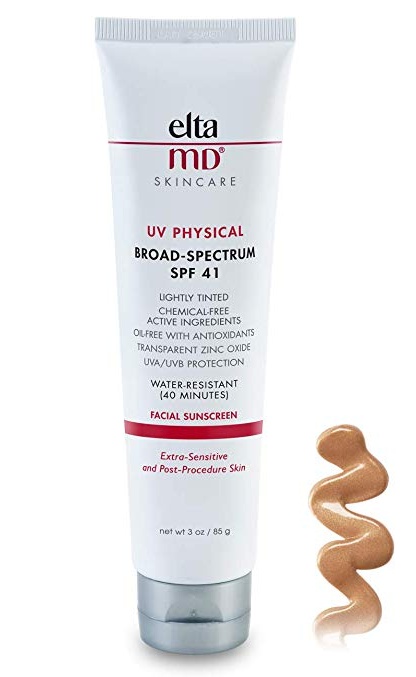
Uv Concrete Tinted Confront Sunscreen Spf 41
Chemic-Free Mineral Sunscreen for Sensitive and Mail service-Procedure Skin.
Uploaded by: samabramspsych on
Ingredients overview
Zinc Oxide, Titanium Dioxide, Alumina, Butylene Glycol, Citric Acid, Dimethicone/Methicone Copolymer, Hydrated Silica, Iodopropynyl Butylcarbamate, Atomic number 26 Oxide, Isopropyl Palmitate, Lecithin, Linoleic Acid, Octyldodecyl Neopentanoate, Octyl Stearate, Oleth-3 Phosphate, Perfluorononyl Dimethicone, Phenoxyethanol, Polyacrylate-13, Polyisobutene, Polysorbate twenty, Purified Water, Quercetin, Sodium Hydroxide, Thioctic Acid (Alpha Lipoic Acid), Triethoxycaprylylsilane
Highlights
Key Ingredients
Other Ingredients
Skim through
| Ingredient name | what-it-does | irr., com. | ID-Rating |
|---|---|---|---|
| Zinc Oxide | sunscreen | 0, one | goodie |
| Titanium Dioxide | sunscreen, colorant | goodie | |
| Alumina | viscosity controlling, annoying/scrub | ||
| Butylene Glycol | moisturizer/humectant, solvent, viscosity controlling | 0, 1 | |
| Citric Acid | buffering | ||
| Dimethicone/Methicone Copolymer | |||
| Hydrated Silica | abrasive/scrub, viscosity decision-making | ||
| Iodopropynyl Butylcarbamate | preservative | ||
| Atomic number 26 Oxide | colorant | 0, 0 | |
| Isopropyl Palmitate | emollient | 1, three-4 | |
| Lecithin | emollient, emulsifying | goodie | |
| Linoleic Acrid | skin-identical ingredient, emollient, surfactant/cleansing | goodie | |
| Octyldodecyl Neopentanoate | emollient | ||
| Octyl Stearate | emollient | ||
| Oleth-3 Phosphate | surfactant/cleansing, emulsifying | 2, 2 | |
| Perfluorononyl Dimethicone | |||
| Phenoxyethanol | preservative | ||
| Polyacrylate-13 | |||
| Polyisobutene | viscosity decision-making | ||
| Polysorbate 20 | emulsifying, surfactant/cleansing | 0, 0 | |
| Purified H2o | solvent | ||
| Quercetin | antioxidant, soothing | goodie | |
| Sodium Hydroxide | buffering | ||
| Thioctic Acid (Blastoff Lipoic Acid) | antioxidant | goodie | |
| Triethoxycaprylylsilane |
EltaMD Uv Physical Tinted Confront Sunscreen Spf 41
Ingredients explained What-it-does: sunscreen | Irritancy: 0
When it comes to sunscreen agents, Zinc Oxide is pretty much in a league of its own. It's a physical (or inorganic) sunscreen that has a lot in common with fellow inorganic sunscreen Titanium Dioxide (TiO2) simply a couple of things make information technology superior even to TiO2.
If physical sunscreens don't tell y'all anything, go ahead and read nigh the nuts hither. About of what we wrote most Titanium Dioxide is too true for Zinc Oxide so we volition focus here on the differences.
The first main departure is that while TiO2 gives a prissy broad spectrum protection, Zinc Oxide has an even nicer and fifty-fifty broader spectrum protection. Information technology protects confronting UVB, UVA Ii, and UVA I almost uniformly, and is considered to exist the broadest range sunscreen available today.
It'south also highly stable and non-irritating. Then much so that Zinc Oxide also counts as a skin protectant and anti-irritant. It's also often used to treat skin irritations such as diaper rash.
As for the disadvantages, Zinc Oxide is too non cosmetically elegant. Itleaves a disturbing whitish tint on the peel, although, according toa2000 inquiry paper by Dr. Pinnell, information technology's slightly less white than TiO2. Still, it's white and agonizing enough to use Zinc Oxide nanoparticles more and more than often.
We wrote more about nanoparticles and the concerns effectually them here, but the gist is that if nanoparticles were absorbed into the peel that would be a reason for legitimate health concerns. But luckily, so far research shows that sunscreen nanoparticles are non captivated but remain on the surface of the skin or in the uppermost (expressionless) layer of the skin. This seems to exist true fifty-fifty if the skin is damaged, for example, sunburnt.
All in all, if you lot've plant a Zinc Oxide sunscreen that you are happy to apply every single day, that's fantastic and we suggest you stick with information technology. It'south definitely one of the all-time, or probably even the best selection out there for sunday protection available worldwide.
Titanium Dioxide is one of the 2 members of the elite sunscreen group chosen physical sunscreens (or inorganic sunscreens if y'all're a science geek and want to be precise).
Traditionally, UV-filters are categorized every bit either chemical or physical. The big divergence is supposed to be that chemic agents absorb UV-light while concrete agents reflect it like a bunch of mini umbrellas on top of the pare. While this categorization is easy and logical it turns out it'southward not true. A recent, 2016 report shows that inorganic sunscreens work mostly by absorption, simply like chemical filters, and only a piffling fleck by reflection (they do reflect the light in the visible spectrum, but generally absorb in the UV spectrum).
Anyway, it doesn't matter if it reflects or absorbs, Titanium Dioxide is a pretty awesome sunscreen agent for two main reasons: it gives a overnice broad spectrum coverage and information technology's highly stable. Its protection is very adept between 290 - 350 nm (UVB and UVA 2 range), and less skillful at 350-400 nm (UVA I) range. Regular sized Titanium Dioxide too has a keen safety profile, it's non-irritating and is pretty much gratuitous from any health concerns (like estrogenic effect worries with some chemic filters).
The disadvantage of Titanium Dioxide is that it'south not cosmetically elegant, meaning it's a white, "unspreadable" mess. Sunscreens containingTitanium Dioxide are oftentimes difficult to spread on the skin and they leave a disturbing whitish tint. The cosmetic manufacture is, of form, actually trying to solve this problem and the best solution so far is using nanoparticles. The itsy-bitsy Nano-sized particles amend both spreadability and reduce the whitish tint a lot, simply unfortunately, it also introduces new health concerns.
The main business organisation with nanoparticles is that they are and so tiny that they are absorbed into the skin more nosotros desire them (ideally sunscreen should remain on the surface of the peel). Once absorbed they might class unwanted complexes with proteins and they might promote the germination of evil free radicals. But do not panic, these are concerns under investigation. A 2009 review article about the safety of nanoparticles summarizes this, "to date, in-vivo and in-vitro studies have not demonstrated percutaneous penetration of nanosized particles in titanium dioxide and zinc oxide sunscreens". The English translation is, then far it looks like sunscreens with nanoparticles do stay on the surface of the skin where they should be.
All in all, Titanium Dioxide is a famous sunscreen amanuensis and for practiced reason, it gives broad spectrum UV protection (all-time at UVB and UVA 2), it's highly stable, and it has a expert safety profile. It's definitely i of the best UV-filter agents we take today, peculiarly in the US where new-generation Tinosorb filters are not (yet) approved.
A multi-functional helper ingredient that's used mainly as a pigment carrier. The pigment can be an inorganic sunscreen (such as titanium dioxide) or a colorant that is blended with alumina platelets and and then frequently coated with some kind of silicone (such as triethoxycaprylylsilane). This special handling enables pigments to be evenly dispersed in the formula and to exist spread out hands and evenly upon application. It is super useful both for mineral sunscreens as well every bit for makeup products.
Other than that, alumina tin can too be used as an absorbent (sometimes combined with the mattifying powder called polymethylsilsesquioxane), a viscosity decision-making or an opacifying (reduces the transparency of the formula) amanuensis.
Butylene glycol, or let'southward just call it BG, is a multi-tasking colorless, syrupy liquid. It'south a great pick for creating a squeamish feeling product.
BG's main job is usually to be a solvent for the other ingredients. Other tasks include helping the product to absorb faster and deeper into the skin (penetration enhancer), making the product spread nicely over the skin (slip amanuensis), and alluring h2o (humectant) into the skin.
It'southward an ingredient whose rubber hasn't been questioned so far by anyone (at least not that we know about). BG is approved past Ecocert and is likewise used enthusiastically in natural products. BTW, it's also a food condiment.
Citric acrid comes from citrus fruits and is an AHA. If these magic iii letters don't tell y'all anything, click here and read our detailed description on glycolic acid, the nearly famous AHA.
So citric acrid is an exfoliant, that can - just similar other AHAs - gently elevator off the expressionless peel cells of your skin and arrive more than smooth and fresh.
There is likewise some inquiry showing that citric acid with regular employ (think iii months and 20% concentration) tin can help sun-damaged skin, increase peel thickness and some nice hydrating things called glycosaminoglycans in the skin.
But according to a comparative report done in 1995, citric acrid has less skin improving magic properties than glycolic or lactic acid. Probably that'south why citric acrid is usually not used as an exfoliant but more every bit a helper ingredient in modest amounts to adjust the pH of a formulation.
 Nosotros don't accept description for this ingredient however.
Nosotros don't accept description for this ingredient yet.
It's one of those things that assistance your cosmetics not to go wrong too soon, aka a preservative. Its strong point is existence effective against yeasts and molds, and as a squeamish bonus seems to exist non-comedogenic as well.
Information technology is safe in concentrations of less than 0.1% but is acutely toxic when inhaled, and then it'southward not the proper preservative selection for droplets formulas like hairsprays. Used at 0.ane%, Iodopropynyl Butylcarbamate has an extremely low rate of skin-irritation when applied directly for 24 hours (around 0.one% of 4,883 participants) and after 48 hours that figure was 0.v%, then it counts as balmy and prophylactic unless your skin is super-duper sensitive.
Besides-chosen: Iron Oxide Reddish;Ci 77491 | What-it-does: colorant | Irritancy: 0 | Comedogenicity: 0
Red Atomic number 26 Oxide is the super common pigment that gives the familiar, "rust" red colour. It is also the i that gives the pink tones in your foundation. Chemically speaking, it is iron III oxide (Fe2O3).
What-it-does: emollient | Irritancy: 1 | Comedogenicity: 3-four
A clear, colorless emollient ester (oily liquid from isopropyl alcohol + palmitic acid) that makes the skin nice and smooth. It has very expert spreading properties and gives a silky touch to the products.
A very common ingredient that can be found in all cell membranes. In cosmetics it's quite the multi-tasker: it'due south an emollient and water-bounden ingredient just information technology'south also an emulsifier and tin can be used for stabilization purposes. It's also oftentimes used to create liposomes.
The famousomega-6 fatty acid,the mother of all ω-6 fatty acids in our trunk. It is a and so-called polyunsaturated fat acid meaning information technology has more than ane (in this case two) double bonds and a somewhat kinky construction that makes LA and LA-rich oils a thin liquid.
It is as well an essential fatty acid pregnant our body cannot synthesize it and has to take it from food. This is not hard at all equally plenty of nuts (such as flax, poppy or sesame seeds) and vegetable oils (such as sunflower or safflower) are rich in LA. The hard thing seems to be eating enough omega-3-s, more than specifically eating a healthy ratio of omega-6 to omega-3, but that is a topic for a what-is-proficient-to-consume-site and non for us.
As for linoleic acid and the pare, LA is a really of import lilliputian guy constitute naturally in our skin. It is the most abundant fatty acid in the epidermis and it serves as a structural precursor for of import peel lipids chosen ceramides. Knowing this, it will not come as a surprise that Linoleic acrid has a primal role in the structure and office of stratum corneum permeability, aka healthy peel barrier. LA deficiency leads to an impaired more than permeable skin barrier and the topical application of LA-rich sunflower oil can fix this issue rapidly (while oleic-rich olive oil did non take the same barrier repairing upshot).
LA is non but important for dry, barrier damaged skin types but also for acne-decumbent peel. Inquiry shows that problem pare has lower levels of linoleic acid (and higher levels of oleic acid) than normal skin. So LA-deficiency in the skin seems to be connected not just to an dumb skin barrier but also to acne and smearing LA all over your face might help with your problem peel. A double-blind study using a 2.5% LA gel for iv weeks constitute a 25% reduction in the size of microcomedones, the tiny blocked pores that can later lead to acne.
If that was not enough, we take i more affair to report well-nigh LA. It lightens hyperpigmentation (aka UVB caused sun spots) both by blocking the melanin production of melanocytes (the peel cells that make the pigment melanin) and by enhancing the desquamation of melanin pigment from the upper layers of the peel.
Overall, linoleic acid is a multi-functional skin goodie with bulwark repairing, acne-reducing, and peel-lightening magic abilities. It'southward a nice one to spot on the ingredient listing pretty much for any skin type.
Nosotros don't have clarification for this ingredient nevertheless.
A clear, almost colorless (or slightly xanthous) oily liquid (an ester to be precise) that's used as a medium spreading emollient. It gives skin a prissy and smooth after-experience and it's very good at reducing oiliness or greasiness coming from other heavier oils in the formula.
A partly h2o, partly oil soluble molecule created by the attachment of (ethoxylated) oleyl booze (oil-soluble office) and phosphoric acid (water-soluble part).
It works every bit an emulsifier helping water and oil to mix and as a dispersing agent helping insoluble solid particles (such as mineral UV filters or pigments) to be evenly dispersed in cosmetic formulas.
We don't have clarification for this ingredient nonetheless.
Information technology'southward pretty much the current It-preservative. It's condom and gentle, but even more importantly, it's not a feared-by-anybody-mostly-without-scientific-reason paraben.
It'south not something new: it was introduced effectually 1950 and today it can be used upward to 1% worldwide. It tin can be found in nature - in greenish tea - simply the version used in cosmetics is synthetic.
Other than having a good condom profile and being quite gentle to the skin it has some other advantages too. It can be used in many types of formulations as it has keen thermal stability (can be heated up to 85°C) and works on a wide range of pH levels (ph 3-ten).
It's often used together with ethylhexylglycerin as it nicely improves the preservative activeness of phenoxyethanol.
A helper ingredient that functions equally a film-forming polymer (big molecule from repeated subunits).
Information technology usually comes to the formula as office of a thickener-emulsifier trio paired with Polyisobutene and Polysorbate 20. The three togeather have excellent thickening properties with remarkable emulsifying-stabilising abilities. They besides take a nice silicone feel with glide-on spreading.
A polymer (large molecule from repeated subunits) that'due south used as a gloss improver for lipsticks and lipglosses. Its stickiness also helps lip products to stay on longer.
Combined with polyacrylate-xiii and polysorbate 20, it forms a very effective tickener-emulsifier trio.
It's a mutual little helper ingredient that helps water and oil to mix together. Also, it tin help to increment the solubility of some other ingredients in the formula.
Too-chosen: Aqua;Water | What-it-does: solvent
Good erstwhile water, aka H2o. The most common skincare ingredient of all. Yous can ordinarily find information technology right in the very outset spot of the ingredient list, meaning it's the biggest matter out of all the stuff that makes upwardly the product.
It's mainly a solvent for ingredients that do not like to dissolve in oils but rather in water.
Once inside the peel, it hydrates, merely not from the exterior - putting pure h2o on the skin (hi long baths!) is drying.
One more thing: the water used in cosmetics is purified and deionized (it means that almost all of the mineral ions inside it is removed). Like this, the products can stay more than stable over time.
Quercetin is a polyphenol flavonoid found in lots of plants, such as carmine onions, broccoli, and blueberries. The reason it is in cosmetics is that - like to other polyphenols - it is a strong antioxidant and has anti-inflammatory properties.
Other than that, a study also showed that adding quercetin to sunscreens helped to stabilize the otherwise not very stable chemical UV filters avobenzone and octinoxate against degradation -- and information technology did ameliorate than traditional stabilizers similar octocrylene and vitamin E!
There are also some studies into the use of quercetin as a skin whitening agent, only subsequently some conflicting results, the determination is that "quercetin is non effective in cosmetic applications equally a whitening ingredient". It also shows pocket-sized cytotoxicity when compared to some of its polyphenol derivatives (such every bit rutin), so quercetin is a skilful case where more than is non ameliorate.
Also-chosen: lye | What-information technology-does: buffering
The unfancy name for information technology is lye. It's a solid white stuff that's very element of group i and used in small amounts to adjust the pH of the production and make it just right.
For case, in example of AHA or BHA exfoliants, the right pH is super-duper important, and pH adjusters similar sodium hydroxide are needed.
BTW, lye is not something new. Information technology was already used by ancient Egyptians to help oil and fat magically turn into something else. Tin can y'all estimate what? Yes, it'due south soap. Information technology nonetheless often shows upwards in the ingredient listing of soaps and other cleansers.
Sodium hydroxide in itself is a stiff skin irritant, simply in one case it'south reacted (as information technology is usually in peel intendance products, like exfoliants) it is totally harmless.
Likewise-chosen: Alpha-Lipoic Acrid | What-information technology-does: antioxidant
Alpha-Lipoic Acid (ALA) is a great antioxidant that's likewise part of the body's natural antioxidant arrangement. It's soluble both in water-rich and lipid-rich environments so it'due south versatile and can interact with many types of evil oxidants also as other prissy antioxidants.
ALA seems to be a great choice for topical use every bit studies bear witness it tin can penetrate the peel rapidly where it'southward converted to DHLA (dihydrolipoic acid), an even more than potent antioxidant molecule. A nicely designed (we mean double-blind, placebo-controlled) 12-calendar week study from 2003 confirmed that 5% ALA cream can decrease skin roughness and ameliorate full general signs of photoaging statistically significantly. A slight catch, though, is thatcalled-for and warmth in the skin was quite a common side effect, especially in the get-go iv weeks.
All in all, ALA is definitely a research-proven, great antioxidant but if your skin is sensitive college concentrations might not exist for yous.
A clear, low-cal yellow liquid that is used to glaze pigments (such as inorganic sunscreen agents or colorants) in cosmetic products. The blanket helps to stabilize pigments in the formulas and also helps them to spread hands and evenly on the skin.
Y'all may besides want to take a wait at...
A physical/inorganic sunscreen with the broadest spectrum (UVB and UVA Ii, less good at UVA I) protection available today. Information technology also has good stability and also works equally a peel protectant, anti-irritant. Might go out some whitish tint on the skin, though. [more than] A physical/inorganic sunscreen with pretty broad spectrum (UVB and UVA Ii, less expert at UVA I) protection and good stability. Might go out some whitish tint on the pare, though. [more] A multi-functional helper ingredient that's used mainly as a pigment carrier helping pigments in mineral sunscreens and color cosmetics to menstruum freely and evenly and not to clump. [more] An frequently used glycol that works equally a solvent, humectant, penetration enhancer and also gives a good slip to the products. [more than] An AHA that comes from citrus fruits. It is commonly used as a helper ingredient to adjust the pH of the formula. [more] Information technology'south one of those things that assist your cosmetics not to go incorrect too shortly, aka a preservative. Its strong point is being effective against yeasts and molds, and as a nice bonus seems to be non-comedogenic as well.It is safe in concentrations of less than 0.1% simply is acutely toxic when inhaled, so it's not the proper preservative choice for aerosol formulas like hairsprays. [more] Iron Oxide - a super common colorant with the color reddish. [more than] A articulate, colorless emollient ester (oily liquid) that makes the skin squeamish and smooth. [more] It's quite the multi-tasker: an emollient and water-binding ingredient but also an emulsifier and can be used for stabilization purposes. It'due south too oft used to create liposomes. [more than] The famous omega-6 fatty acid, the female parent of all ω-6 fat acids in our body. It is a then-called polyunsaturated fatty acrid meaning it has more than one (in this case two) double bonds and a somewhat kinky structure that makes LA and LA-rich oils a thin liquid.It is too an essential fatty acrid meaning our torso cannot synthesize [more] A clear, near colorless oily liquid that's used every bit a medium spreading emollient. Information technology gives skin a overnice and smooth subsequently-experience and it's very good at reducing oiliness or greasiness coming from other heavier oils in the formula. A partly water, partly oil soluble molecule created by the attachment of (ethoxylated) oleyl alcohol (oil-soluble role) and phosphoric acid (water-soluble role). Information technology works as an emulsifier helping h2o and oil to mix and as a dispersing amanuensis helping insoluble solid particles (such as mineral UV filters or pigments) to exist evenly dispersed in cosmetic formulas. [more] Pretty much the current IT-preservative. It's safe and gentle, and can be used up to 1% worldwide. [more than] A film forming polymer that unremarkably comes to the formula every bit role of a thickener-emulsifier trio paired with Polyisobutene and Polysorbate 20. [more than] A polymer (big molecule from repeated subunits) that'southward used every bit a gloss addition for lipsticks and lipglosses. Combined with polyacrylate-13 and polysorbate 20, it forms a very effective tickener-emulsifier trio. [more] Information technology's a common piddling helper ingredient that helps water and oil to mix together. Also, it tin can help to increase the solubility of some other ingredients in the formula. Normal (well kind of - it's purified and deionized) water. Ordinarily the main solvent in corrective products. [more] Quercetin is a polyphenol flavonoid found in lots of plants, such every bit reddish onions, broccoli, and blueberries. The reason it is in cosmetics is that - similar to other polyphenols - information technology is a strong antioxidant and has anti-inflammatory backdrop. Other than that, a study besides showed that adding quercetin to sunscreens helped to stabilize the otherwise not very stable chemical UV filters a [more] Lye - A solid white stuff that'southward very alkaline and used in minor amount to adjust the pH of the product. [more] Alpha-Lipoic Acrid (ALA) is a great antioxidant that'southward also part of the body's natural antioxidant system. It's soluble both in water-rich and lipid-rich environments and then it's versatile and tin can interact with many types of evil oxidants also as other nice antioxidants. ALA seems to be a great choice for topical use equally studies show information technology tin can penetrate the skin rapidl [more than] A clear, light yellow liquid that is used to coat pigments (such every bit inorganic sunscreen agents or colorants) in corrective products. [more]
johnsonhichaveste.blogspot.com
Source: https://incidecoder.com/products/eltamd-uv-physical-tinted-face-sunscreen-chemical-free-mineral-sunscreen-for-sensitive-and-post-procedure-skin-broad-spectrum-spf-41
0 Response to "Eltamd Uv Physical Tinted Facial Sunscreen Broad-spectrum Spf 41 Review"
Post a Comment